Thank you for subscribing!
Conservative MP Katie Lam has voiced fears over the ramifications new Labour proposals could have for veterans
Nearly thirty years ago, the Belfast Agreement brought the worst of the violence in Northern Ireland to an end.
This was a hard-won peace. British security personnel, including soldiers and the police, had worked for decades to keep civilians safe from terrorism. They worked bravely and professionally, constrained by rules of engagement which did not bind their enemies. Thanks to their efforts, the terrorist groups which had taken so many innocent lives in Northern Ireland – most notably the Provisional IRA – were forced to the negotiating table. It looked, for all the world, as if democracy and the rule of law had won.
But almost thirty years on, people with their own agendas are increasingly succeeding at undermining the consensus which built that peace.
For years, figures within Irish republicanism have worked to present their cause as entirely noble, and largely blameless.
We often hear that IRA volunteers were ‘forced into’ their actions – which included murdering civilians and assassinating police officers. The British security forces are presented as brutal occupiers, bent on the oppression of Northern Ireland’s Catholic population – despite the fact that, when the British Army was deployed in 1969, it was with the explicit aim of protecting Catholic civilians. Some republican groups have worked to prosecute British veterans, with the aim of vindicating these narratives.
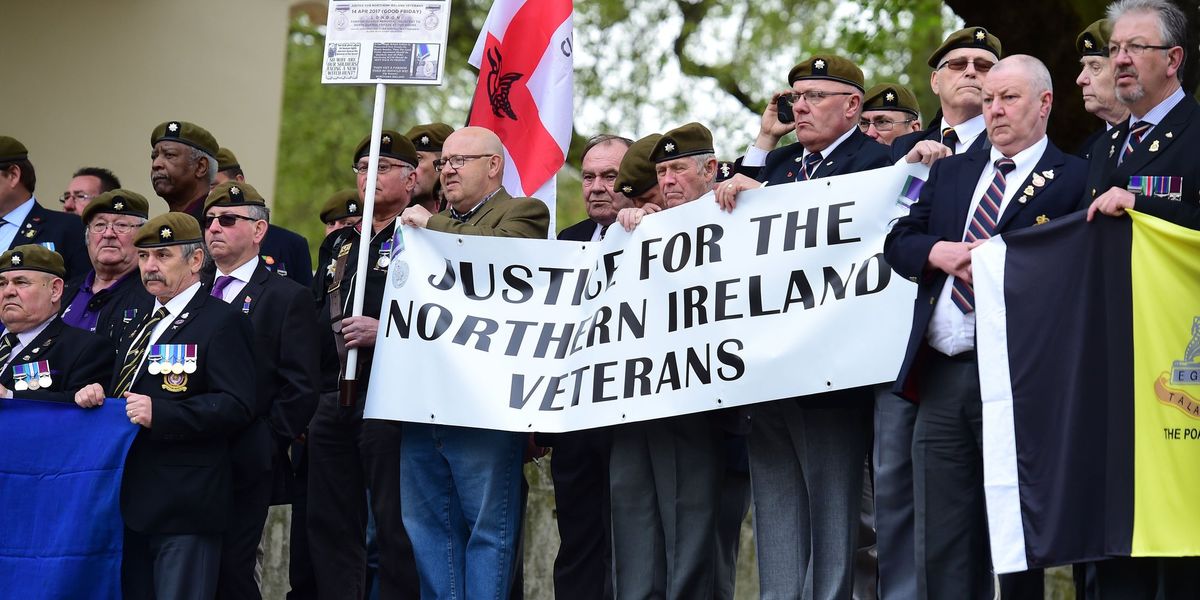
For their part, those who served in Northern Ireland have largely remained quiet. Many have faced prosecution, or legal harassment, for decisions taken decades ago, entirely legally, with the aim of protecting civilians from terrorist violence.
As a result, the truth has, unfortunately, often fallen by the wayside. According to a 2023 poll, 37 percent of people aged 18-34 in the Republic of Ireland believe that the British Army was responsible for the most deaths during the Troubles of any group involved; a further 28 percent said that they weren’t sure. Just 14 percent said that they thought that Republican paramilitaries, like the Provisional IRA, had been responsible for the most deaths.
In fact, more than half – 58 per cent – of deaths during the Troubles were caused by Republican paramilitaries. Fewer than one in 10 were caused by the British Army.
The same poll showed that a third of young people in the Republic thought that it was acceptable to say ‘Up the RA’ – a pro-IRA slogan. Meanwhile, groups like Kneecap glamorise the Provisional IRA as freedom fighting rebels.
But the truth is far less glamorous. The IRA killed more than 1,700 people between 1969 and 1998, including more than 500 civilians. In 1972, members of the IRA kidnapped Jean McConville, a widowed mother of ten, wrongly believing that she was passing information to the British Army.
She was murdered, and her body was buried in an unmarked grave, undiscovered until 2003. That people feel comfortable expressing support for a group which commits acts of such brutality is a sign that something has gone horribly wrong.
It would be bad enough if the truth were the only casualty of this sustained propaganda campaign.
Unfortunately, it’s exactly this republican story of the Troubles which has created the political space for the ongoing legal harassment of Northern Ireland veterans, and for the continued refusal to pay compensation to many civilian victims of the IRA’s campaign of terrorism. As they push to remove the legal protections that exist for our veterans, even our own Government seems to believe the revisionist narrative.
Earlier this year, I travelled to Northern Ireland with Outpost Studios, to hear about the Troubles from the people who had lived through them. I spoke to people of all sides and none – republicans, loyalists, civilian victims, and members of the British security forces and police. The gap between the popular narrative and the grim reality was stark.
Most of all, I was struck by the incredible forgiveness that it took to bring the conflict to an end – a forgiveness which has not, in recent years, always been extended evenly. The Government’s plans to open up Northern Ireland veterans to prosecution will inevitably mean more historical revisionism, and more harassment of people who served bravely in an attempt to bring the violence to an end.
If we ever hope to move on from the Troubles, they must scrap these disastrous plans.