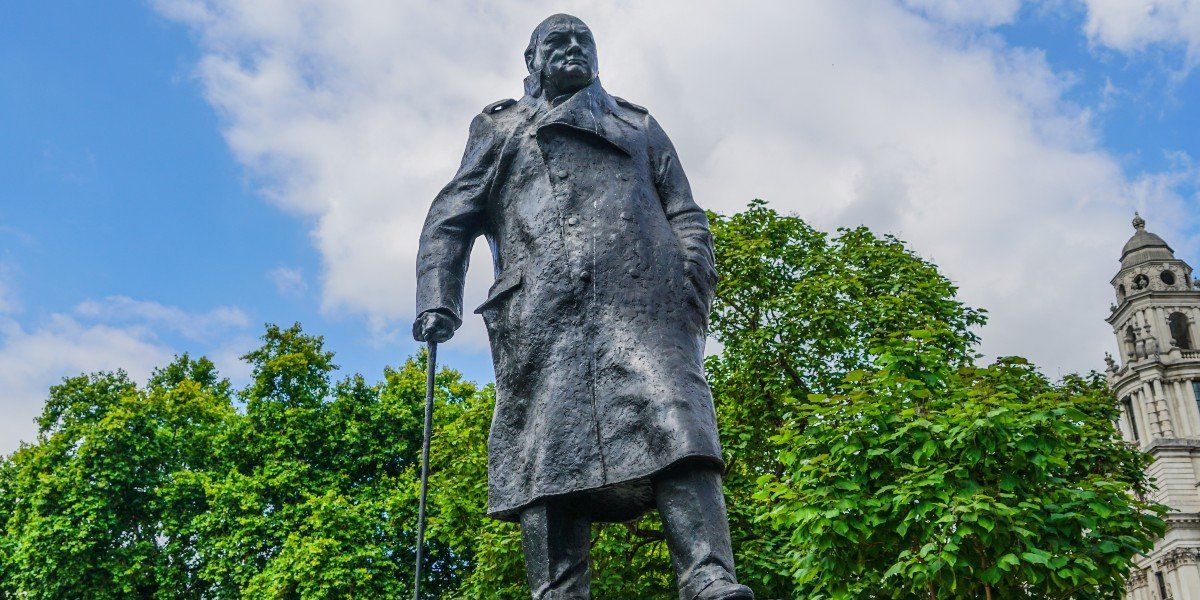
Without Churchill, the very members of the public who claim to be ‘upset’ would be speaking German, writes the GB News presenter
Why is everyone, alive or dead, famous or not, judged by a single act in their life?
Whether it be a controversial or contentious act, or perhaps something they did which was utterly wonderful and charitable. It appears to have become so much easier to judge people in the most binary terms.
What’s worse is that, in some cases, rather than face the truth about prominent people, we’re erasing them altogether.
The National Portrait Gallery is being hugely criticised for an exhibit which claims - as fact- the wartime Prime Minister engaged in the ‘wilful starvation of the Indian people’ during the Bengal famine. It also says Churchill used this as a ‘weapon of war’. This isn’t put forward as a point of debate, it’s stated in a video as the truth.
One defender of Churchill, his biographer Lord Roberts of Belgravia, has furiously written to the gallery accusing them of a ‘barefaced lie’. It’s been signed by fifty peers. One of the signatories, Churchill’s grandson Lord Soames, has called the suggestion his grandfather deliberately starved Bengalis as ‘foul and vile’.
But unfortunately, it couldn’t be clearer nowadays that one opinion you might hold, one accusation you may have been subjected to, one action you may have taken, good or bad, however well or ill intentioned, has to become the basis of your entire character, and the benchmark for which you are judged, forevermore.
Of course, this method of black and white judgement appears to work out particularly well if you’re in the category of being judged for an action considered ‘good’. But not so if you’ve ever done anything considered remotely controversial. And let’s face it, most people have.
I’ve no idea whether the actions Winston Churchill took during 1943 knowingly or unknowingly meant Bengalis were without food. Perhaps I am incredibly callous, or perhaps I am able to comprehend that Churchill was fighting for Britain’s life, its culture and its future during a brutal world war. Decisions had to be taken. Strategies had to be employed. Resources had to be allocated.
Everything I've read actually points to Churchill doing all he can to try to avert a famine, which was more likely caused by the massive typhoon in the region, as well as the Japanese occupation of Burma. There’s a lot of evidence to also suggest Churchill tried to divert what scarce resources there were during the war to try and help the Bengali people, especially when he called on Allies to assist by diverting supplies to the region.
And let’s be clear, it’s absolutely dreadful that people died in that horrific famine. But my sorrow for them does not outweigh my immense gratitude that the decisions Churchill made, whether good or bad, mean I am currently writing this for you in English and not German.
Why can’t this nuance be seen by institutions meant to educate people?
I have no problem whatsoever with the gallery acknowledging there’s a school of thought that Churchill acted badly, for whatever reason, when it came to the food shortages of that time. It’s a fact that people believe he was at most completely responsible or, at the very least, didn’t do enough to help. Acknowledging this is precisely what exhibits should do, before offering up impartial evidence for people to then be informed as to what really happened.
The problem here is that what Churchill is accused of is being stated as fact from an institution which should not only know better, but should also be politically neutral.
But this issue goes to the heart of what appears to be wrong in our society when it comes to our judgement of people and their record. Because we no longer see those people as rounded characters. We no longer see the good and bad in people. It’s all become so utterly, exhaustingly binary. You’re either a hero, or villain. Good or bad. Intelligent or thick as two short planks. This does history, and more importantly, society a huge disservice.
I’m quite sure Mother Theresa was absolutely wonderful, but I’m sure we’ll never hear about how she could be a complete harridan if she ever lost a sandal.
But we no longer debate figures of history accurately, or see them as anything other than one- dimensional. How will we ever learn anything this way? How will we be able to inform the next generation of both the positives and negatives when it comes to not only historical characters but the people they meet in day-to-day life too if we don’t give an accurate representation of their flaws as well as their virtues? Yes, it’s complicated to see people as more than just one thing, as nuanced, but isn’t that how people are?
It appears it’s become way easier and safer to just put people into neat little boxes instead, but life just doesn’t work this way.
Something even more worrying is now happening though when it comes to figures from history whose legacy requires nuance. Rather than debate them, we’re simply erasing them.
Nowhere better is this demonstrated by Churchill, and other figures being removed from our banknotes. The Bank of England are claiming he, as well as Alan Turing and Jane Austen, are “contentious and not representative of the UK’s cultural and natural diversity”. Officials were advised to drop their portraits from our currency as they represent “a backward-looking vision of the UK that carries too great a risk of division and controversy”.
The research group that reported back their findings, which brought about this change, claimed Churchill and others risk ‘upsetting’ some members of the public. I hate to labour this point, but without Churchill, those members of the public would be feeling traurig (German for ‘distressed’) before probably heading home to console themselves with a lovely helping of Bratwurst.
If there is an accusation these figures are ‘contentious’ then how does erasing them help? What do these people who make these decisions actually fear? That someone might see a picture of Jane Austin on a bank note, and require CPR due to feeling ‘upset’? Might they require smelling salts at the mention of Alan Turing on a £50 note?
So the Bank of England have decided to replace those images with… pictures of wildlife.
Apparently, they’d toyed with the idea of historical buildings being featured instead, but then panicked that again someone might be ‘upset’ at the thought of seeing a structure which might have been built hundreds of years ago before full health and safety regulations were in place.
So we’ll now be seeing the great British… Dolphin (?), and other wildlife appear on our currency. Obviously, this makes no sense, but at least no one sensitive will be offended. That is, until the endless complaints arrive from those who suffer from Delphinophobia, which is a phobia of Dolphins. At that point, we can fully expect the Bank of England to play it even safer, and just feature a tin of Magnolia paint on banknotes instead.
What we could do of course, as they could in the National Portrait Gallery, is offer the chance to debate these ‘controversial’ people and their history. We could acknowledge what flaws they might have, but celebrate their achievements. Maybe we could open up the chance to have a conversation instead by allowing our population to see these people, and then research them?
We are doing people no favours by trying to ‘protect’ them from being upset by simply erasing history. Let’s debate their legacy. Let’s have honest discussions about what they were actually like. Let’s face up to difficult conversations and allow things into our lives which might make us ‘upset’ or uncomfortable.
Of course, this won’t change anything they may or may not have done, but it does mean we can learn lessons, inform ourselves along the way, and spare ourselves from the inevitable beige banknotes of the future.