Thank you for subscribing!
The undisturbed arrangement of these items provides rare direct evidence of Old Kingdom funerary practices
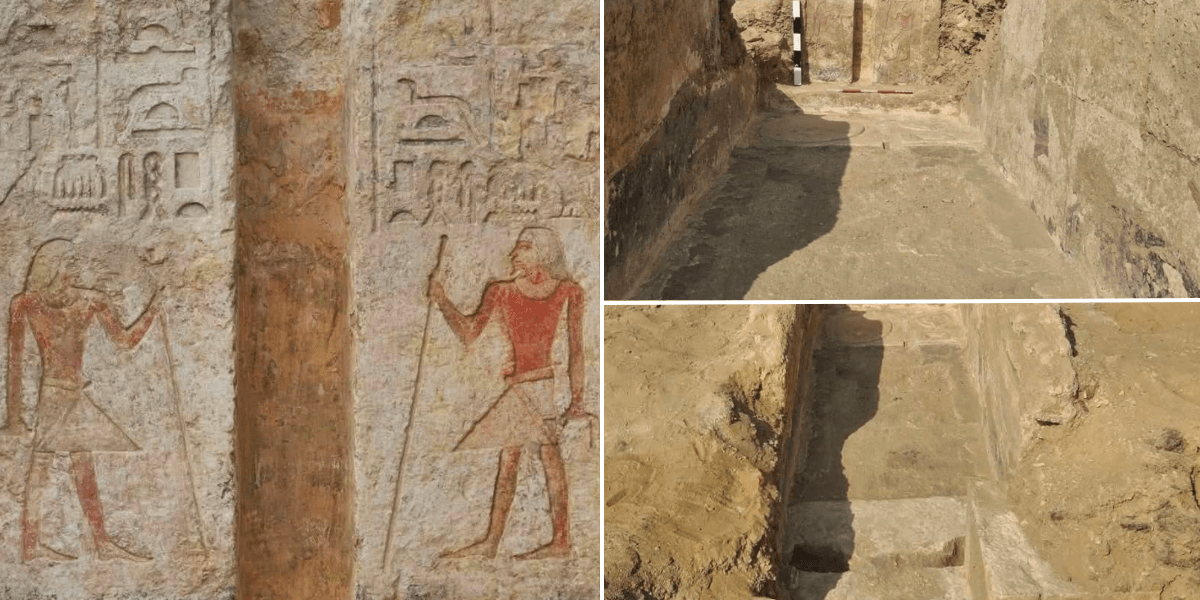
An Egyptian archaeological team working in Sector A of the Saqqara cemetery has unearthed the tomb of Sekhentiu-Ptah, a senior royal official from the Old Kingdom period in a stunning discovery.
The find, made at the Bubastion necropolis, revealed a funerary chapel with its false door still standing in its original position.
Directly in front of the door, excavators recovered a full set of alabaster ritual objects, all found precisely where they had been placed thousands of years ago.
The collection comprises an offering table, an offering disk, a purification basin, a jug, and a basin.
The undisturbed arrangement of these items provides rare direct evidence of Old Kingdom funerary practices, as archaeologists were able to record each object in situ during the mission's first season of fieldwork.
Hieroglyphic inscriptions found on the alabaster objects identify the tomb's occupant by name and enumerate a string of prestigious titles.
Sekhentiu-Ptah served as royal chamberlain, overseer of all the king's works, and overseer of royal documents.
He also held the positions of keeper of the secrets of royal commands, priest of the goddess Maat, and overseer of scribes.
Taken together, these designations indicate a figure who occupied a prominent position within the pharaonic state apparatus.
The range of responsibilities — spanning construction projects, sacred duties, and the administration of written records — points to considerable authority at the highest levels of government.
For researchers, the inscriptions offer a sharper picture of how the Old Kingdom court was structured and where Sekhentiu-Ptah fitted within its hierarchy.
Alongside the Old Kingdom tomb, the mission uncovered a connected group of burial shafts dating to considerably later periods.
These yielded numerous human remains, substantial quantities of painted funerary cartonnage and more than 100 faience ushabti figures.
Three stone coffins were also retrieved with their seals entirely intact.
Additional finds included a wooden falcon figure, pottery vessels and various other grave goods characteristic of Egypt's Late Period.
Evidence of ancient looting was apparent in several shafts, where robbers had broken through walls between burial chambers.
Despite this interference, a significant number of objects survived undisturbed.
The positioning of these surviving artefacts has given the team valuable information about the cemetery's internal organisation and how its architecture evolved over successive generations.
The combination of Old Kingdom and Late Period burials demonstrates how this stretch of the Saqqara necropolis served successive communities over many centuries.
The findings further illuminate the role of the Bubastion necropolis within the broader Saqqara burial landscape.
The team is currently engaged in detailed documentation work, encompassing architectural analysis, inscription study, digital recording, and photographic surveys.
Comparisons with material from other Egyptian sites also form part of the ongoing research programme.
Publication of the results in specialist peer-reviewed journals is planned once further analysis has been completed.
Excavation in the area is set to continue, with early indications suggesting that additional structures and objects may remain buried beneath the surface.