Thank you for subscribing!
The precise location of the pivotal battle has long bewildered historians until now
Two metal detectorists have uncovered the location of one of the most significant moments in English history.
Simon Richardson and John Benfield have unearthed a substantial collection of Viking military artefacts along the banks of the River Derwent, roughly a mile from the present-day town of Stamford Bridge in Yorkshire.
Their findings, which include fragments of Norse swords, spearheads, arrowheads and pieces of chain mail, feature in a new documentary on the History Hit streaming platform, The Times reports.
Titled "1066: The Lost Battlefield" and presented by historian Dan Snow, the film chronicles the pair's efforts to resolve a mystery that has eluded scholars for nearly a millennium: where precisely Harold Godwinson's Anglo-Saxon army defeated the Norwegian invasion force in 1066.
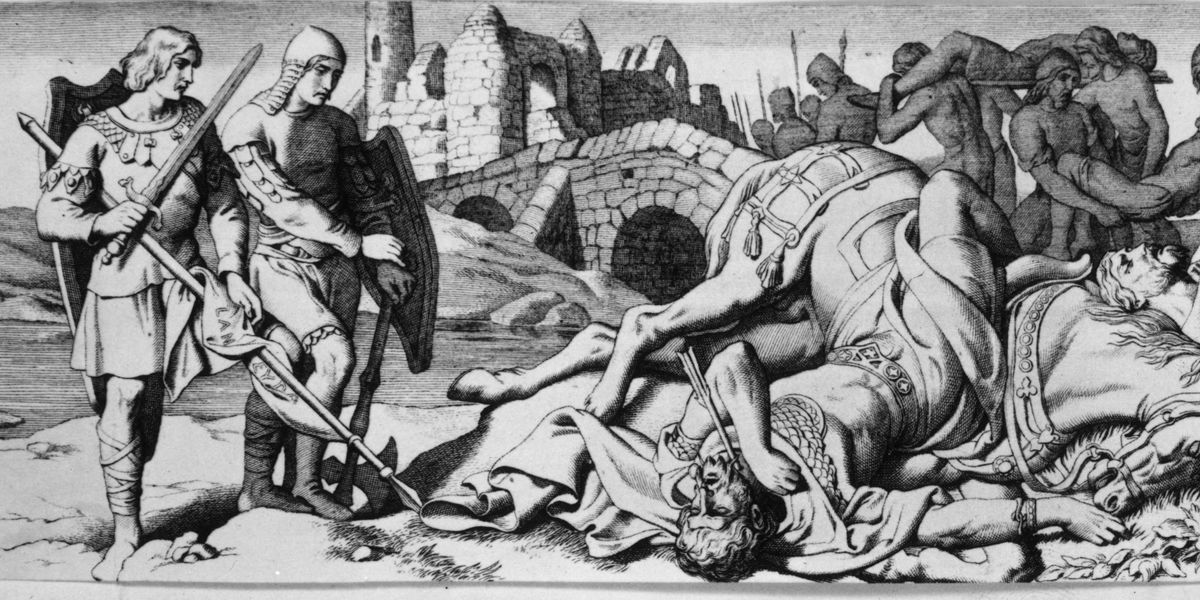
The confrontation occurred on September 25, 1066, the second in a trio of epoch-defining engagements that year.
Harold Godwinson had seized the English throne following the death of the heirless Edward the Confessor but faced rival claims from both William of Normandy and Harald Hardrada, Norway's king.
Hardrada landed in England in early September and captured York after triumphing at the Battle of Fulford on September 20.
Five days later, his troops, wearing only light armour, proceeded to Stamford Bridge for a planned hostage exchange with local Northumbrians.
They were caught entirely off guard by Godwinson's army, which had marched north with remarkable speed.
The resulting clash proved a resounding Anglo-Saxon victory and cost Hardrada his life — yet Godwinson himself would fall at Hastings merely three weeks afterwards.
The precise location of this pivotal battle has long bewildered historians.
Historic England has acknowledged the name "Stamford Bridge" has posed considerable difficulties in determining exactly where the fighting took place.
Although the modern town claims the battle as its own, it presents a fundamental problem: no bridge existed there in 1066.
The settlement does not even appear in the Domesday Book compiled by the Normans after the conquest.
Mr Richardson and Mr Benfield favoured an alternative theory.
An old Roman settlement near Low Catton, approximately a mile from the present town, is known to have possessed a bridge — the very feature central to every chronicle account of the engagement.
Having secured the landowner's consent, the pair began scanning the terrain and their detectors responded almost at once.
Among the most significant items is a scabbard end from a Viking sword, traced to Eastern European origins — a detail that aligns neatly with Hardrada's personal history.
The Norwegian king forged his reputation fighting across Eastern Europe and serving the Byzantine Empire.
A sword crossguard recovered from the site shares similar provenance.
Dan Snow expressed firm confidence in the identification, saying: "I'm convinced this is the site.
"The experts are persuaded by the evidence. Vast amounts of 11th-century weaponry has been found. In fact it's all that's been found. There are no other objects from different time periods. This was a field of destruction."
The absence of artefacts from other eras strengthens the case that this ground witnessed a single, devastating episode of violence.
Mr Richardson emphasised the absence of everyday objects and pointed firmly towards a battlefield rather than a settlement with a stockpile of arms.
"Everything was sort of battle- or warrior-related — we didn't find anything domestic, like women's hairpins or brooches," he said.
The initial discoveries date back to 2020 and prompted a second excavation, documented in the History Hit film.
The Battle of Stamford Bridge Heritage Society has lent its support throughout.
A change of landowner means the detectorists must seek fresh permission to continue their work.
Should access be granted, they hope to recover sufficient material to furnish a museum, ideally in Stamford Bridge itself.
"We don't keep things," Mr Richardson said. "We like to share them."