Thank you for subscribing!
Their skeletons were uncovered after a passer-by stumbled across part of a motorbike poking out of the mud
A pair of Nazi soldiers have been pulled from a riverbed after lying hidden for more than 80 years.
The remains of the soldiers - one of which was a member of the Waffen-SS, were found in a section of the River Danube that winds through Hungarian capital Budapest.
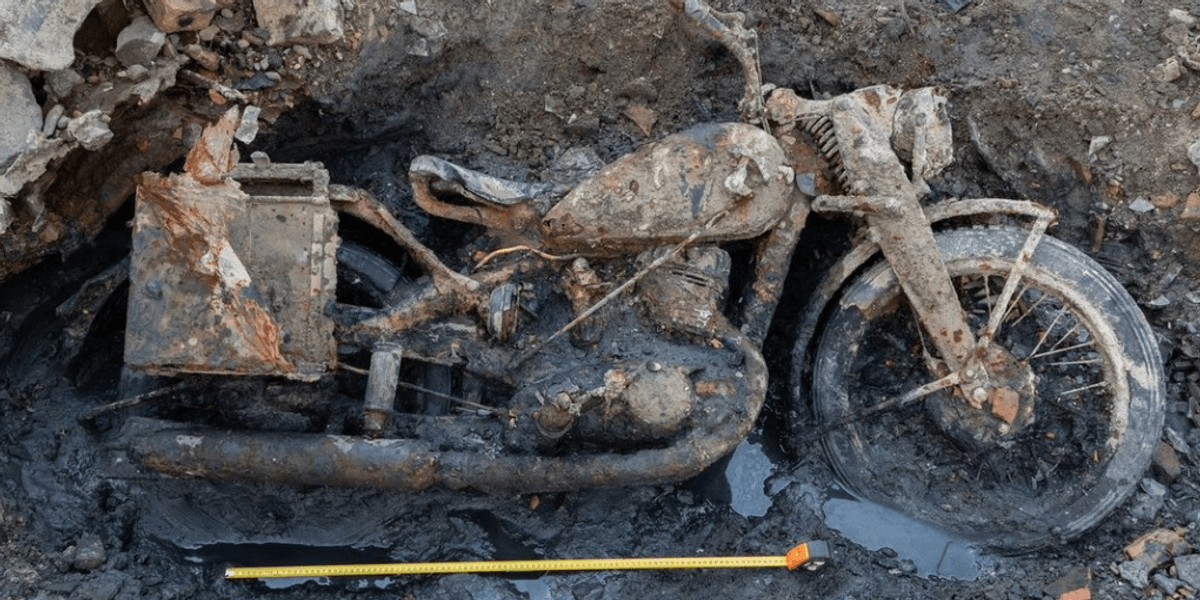
Also found near the two men was a well-preserved army motorcycle.
A passer-by found the remains and artefacts on August 2 after noticing a part of the DKW NZ 350-1 bike, built specifically for the German military, poking out of rocks on the riverbank in downtown Budapest.
The discovery was only possible because of the heatwave, which dried up the river.
Also preserved in the mud were their two dog tags, or identity markers, a wedding ring, and a combat badge know as the Kuban shield.
The identity discs, worn by German soldiers, were designed to be split in two.
One half was to stay with the dead body and the other sent to the Wehrmacht Information Office in Berlin so families could be told of their deaths.
But the discs with the two men remain in one piece - meaning their families likely never learned how and why they died.
Relatives would have "waited in vain" for any news of their death, the German War Graves Commission said.
The Kuban shield was granted to soldiers who served in 1943 at the Kuban bridgehead, between the Black Sea and the Sea of Azov, in the south of modern-day Ukraine.
Anti-tank mines were also found in the riverbed, forcing bomb disposal experts to be called in and the temporary closure of a section of the riverbank.
MARVELLOUS FINDS - READ MORE:
"Now begins a puzzle, in which we will try to determine the identity of the two dead," Arne Schrader of the German War Graves Commission told the German newspaper Bild.
The commission, a German non-profit which searches, recovers, and buries the dead of World War Two, has began its investigation to identify the soldiers.
Despite the presence of the dog tags and Kuban shield, it is not known if the artefacts actually belonged to the soldiers.
"The names of the original wearers can probably be found quickly, but that is only the first step," the commission said.
"Too many pieces of the puzzle need to be gathered, and the outcome is uncertain."
Bone analysis will also be used to determine the soldier's identities.
The remains will be buried at the German war cemetery in Budaors, just outside the Hungarian capital.
Budapest was home to fierce fighting in the closing months of the war as German and Hungarian troops were besieged by Soviet forces.
The Red Army entered Hungarian territory in late 1944, fought a brutal campaign to push out German forces, and completely cleared Nazi troops by April 1945.
The Soviets took control of the country, and only really relented in 1991 when the Warsaw Pact dissolved.