Restoration efforts have succeeded in piecing together more than 25 per cent of the complete ceiling thus far
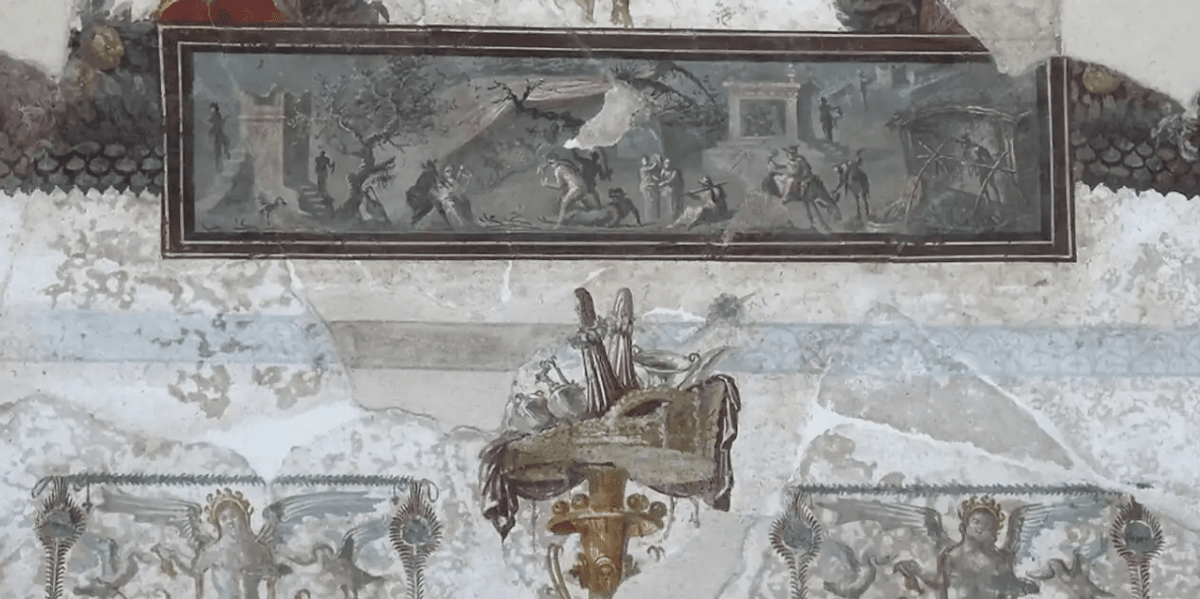
Archaeologists working at the ancient site of Pompeii have revealed a reconstructed section of an ornate ceiling vault covered in frescoes, which researchers believe once adorned a banqueting chamber on an upper storey of a dwelling connected to a bakery.
The vault's paintings portray mythological imagery centred on the Greek figures of Dionysus, deity of wine and celebration, and Ariadne, a Cretan princess.
Researchers identified this legendary pairing as the artwork's principal subject matter.
The restoration work was displayed on Thursday at the conclusion of an international workshop examining fresh finds and conservation efforts at the archaeological site.
Pompeii Archaeological Park announced on Friday specialists had employed an innovative method to rebuild the vaulted ceiling, fashioning a curved framework to hold the pieces in a configuration that mirrors the structure's original curved form.
Restoration efforts have succeeded in piecing together more than 25 per cent of the complete ceiling thus far.
The construction allows for ongoing additions to be incorporated whenever fresh fresco portions are discovered and undergo conservation treatment, according to park officials.
The ceiling fragments have been identified as originating from what researchers think served as a dining room situated on an upper level of a residence with a bakery attached.
Gabriel Zuchtriegel, who directs the Pompeii excavations, emphasised the nation's pre-eminence in this field of work.
"Italy is a world leader in archaeological restoration, and Pompeii, with its team of restorers, plays a central role in that effort," he told the Italian news agency ANSA.
"That is why we are pleased to share the results of our conservation projects with the world, as they also provide opportunities for research and exchange."
The reconstruction forms part of the archaeological park's 2026 initiative dedicated to Dionysus.
This programme follows on from finds at the House of Thiasos in Regio IX, where excavators brought to light a major fresco showing a procession honouring the Greek deity, ranking amongst the most important large-scale wall paintings discovered at the location.
The ancient Roman settlement was destroyed when Mount Vesuvius erupted in 79 AD, burying the once-flourishing city beneath volcanic ash.
The site now holds Unceso World Heritage designation and attracts large numbers of visitors to Italy.
Recent years have yielded significant archaeological finds at Pompeii.
Last year, excavators uncovered an extensive private bathhouse complex, described as a once-in-a-century discovery, featuring facilities that could serve up to 30 people, including a substantial plunge pool and chambers of varying temperatures.
In March of this year, more than 20 plaster reproductions of eruption victims entered a permanent display for the first time.
These casts, created by filling voids left by decomposed bodies in the solidified ash, preserve the precise positions in which residents perished during the catastrophic event.