Thank you for subscribing!
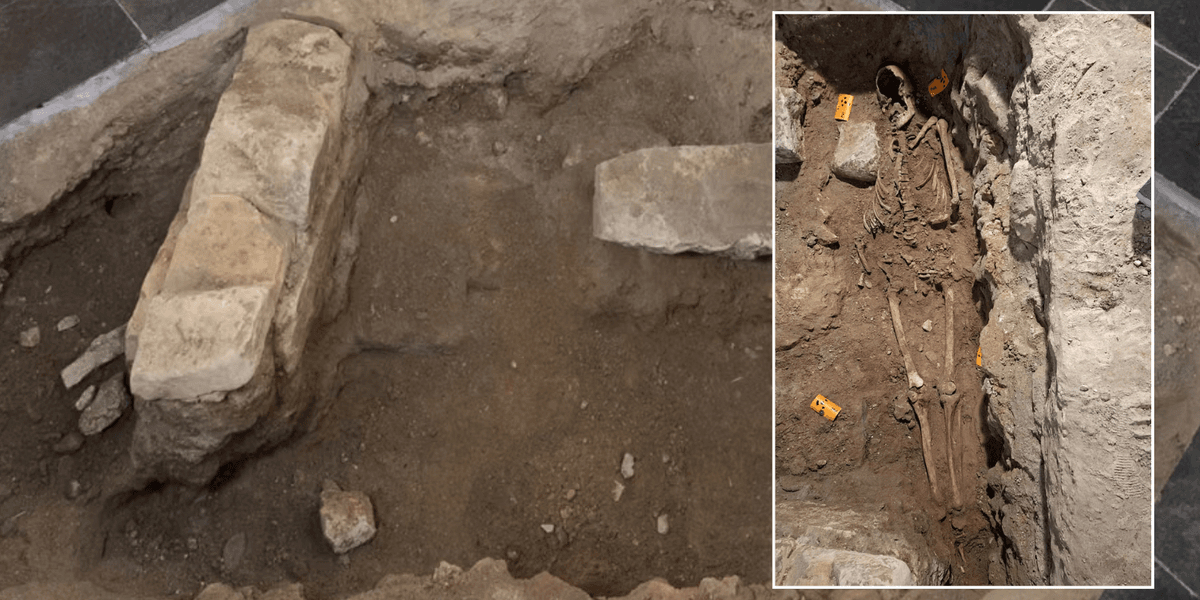
After a dig in January and February 2026, the skeleton was found near a church altar in the Netherlands
An archaeology row has erupted five months after a skeleton was unearthed in the Netherlands, with questions over whether it belongs to the real fourth musketeer d'Artagnan.
"How is the research going? That's the question every visitor asks us," said Alina Goebel, who runs the d'Artagnan Museum in the musketeer's birthplace of Lupiac in south-western France.
The historical figure behind Alexandre Dumas's literary hero – Charles de Batz de Castelmore, born in Gascony between 1610 and 1615 – was struck down by a musket ball during the siege of Maastricht on June 25, 1673.
Louis XIV, present at the siege, ordered a mass in honour of his most devoted servant – yet for 353 years, no one has been able to locate his grave.
Historian Odile Bordaz, widely considered the foremost authority on the real d'Artagnan, had pointed to Wolder, a residential district of Maastricht, as a likely burial site as far back as 2005.
Archaeologist Wim Dijkman had also spent nearly three decades pursuing the mystery of d'Artagnan's burial.
After the local parish at Saint-Pierre-et-Paul Church finally consented to excavations in 2025, Mr Dijkman – by then retired – found himself shut out by the municipality and his successor, Gilbert Soeters, with whom relations had soured.
Undeterred, he pressed ahead without official authorisation in January and February 2026, locating the skeleton near the church altar.
"If this is d'Artagnan, it will be the peak of my career," he declared.
The Maastricht city council said it discovered the dig by chance and immediately declared it illegal on March 5.
By April 27, Mr Dijkman was made a Knight of the Order of Orange-Nassau for his archaeological contributions.
Three weeks later, on May 20, he was arrested on suspicion of conducting unlawful excavations and possessing bones.
The municipality's own emergency excavation on March 13, conducted by anthropologists from Saxion University of Applied Sciences and the archaeological agency BAAC, yielded a mixed picture.
Physical analysis confirmed the remains belonged to a man approximately 1.74 metres tall and aged between 44 and 66 – broadly compatible with d'Artagnan.
Other findings proved less encouraging, as mass spectrometry showed the object initially identified as a musket ball was in fact a 3.3-gram iron nail fragment.
Radiocarbon dating also offered little clarity, producing a range spanning 1500 to 1900 AD.
Most unexpectedly, collagen analysis indicated the individual's diet comprised 27 to 30 per cent marine fish — a proportion far exceeding what would be expected of someone from Gascony who lived mainly in Paris and Lille and more consistent with eating habits in eastern and southern Europe.
Maastricht city hall is now funding fresh ancient DNA analysis, which it has described as a "crucial step", with a sample extracted from the root of a molar to help determine the individual's geographical origins.
The work is being overseen by Professor Maarten Larmuseau, a genetic genealogist at the University of Leuven in Belgium, renowned for cracking historical cold cases.
Yet even DNA may not settle the matter, as D'Artagnan's direct line died out in the mid-nineteenth century, meaning any comparison would require tracing distant indirect descendants — a genealogical puzzle spanning several centuries.
"I keep hoping until the last minute, but is it really realistic? I don't want to give in to too romantic a vision," said Maastricht's mayor, Wim Hillenaar.