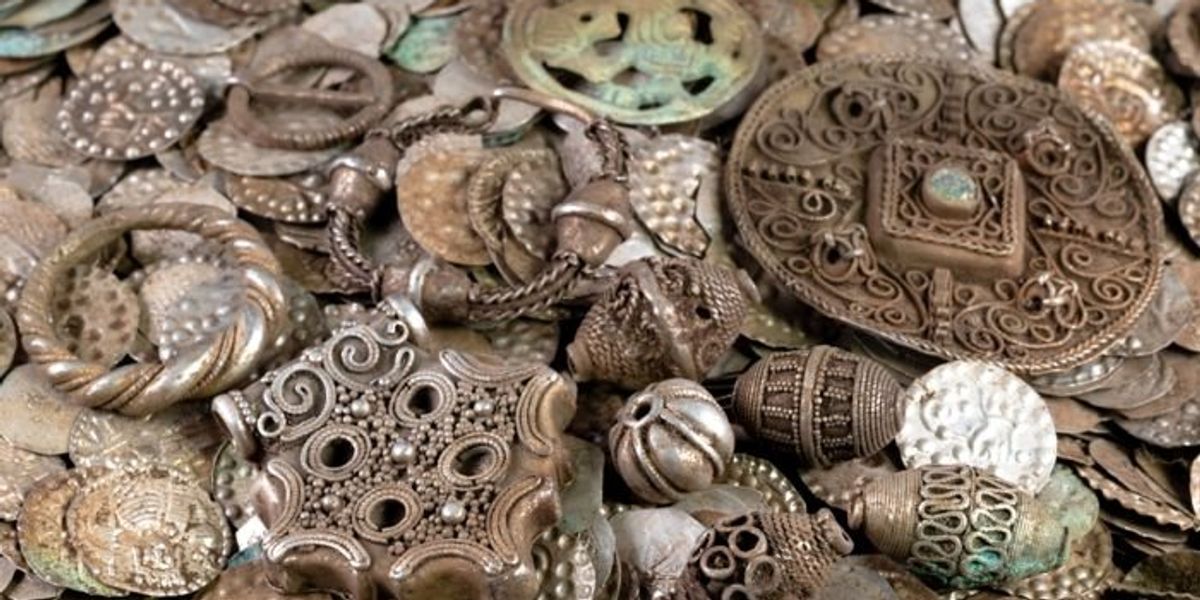
A fisherman digging for bait worms in Sweden discovered a cauldron filled with historic treasure.
The medieval hoard, which weighed around six kilograms, was found near to the man's summer house in the Stockholm area.
It consisted of "well-preserved" silver treasure dating back to the early Middle Ages, the Stockholm County Administrative Board said.
This included silver coins, rings, pendants and beads, all discovered inside a copper cauldron.
Archeologists are now investigating the site as well as the treasure discovered.
Antiques-expert Sofia Andersson, of the County Administrative Board, said: "This is probably one of the largest silver treasures from the early Middle Ages that has been found in Sweden.
"We don't yet know exactly how many coins there are, but I think it could be upwards of 20,000.
"Most of the objects are well preserved, but the copper cauldron in which they were found is unfortunately not as well preserved."
Some of the coins featured an inscription referencing Knut Eriksson, who was King of Sweden at the end of the 12th century.
"During the Middle Ages, so-called bishop coins were minted in Europe, meaning coins made for a bishop," the County Administrative Board stated.
"The hoard contains several such coins where a bishop is seen holding a crozier in his right hand."
In another recent archeological discovery, a section of Hadrian's Wall was uncovered during a three-week excavation near Carlisle.
The Roman structure once straddled the border between the northern extent of the ancient empire and Caledonia, now Scotland.
Construction began on the herculean project in 122AD, intended to defend the province of Britannia from roving invaders, with this new section having remained hidden for 2,000 years.
The western section of the wall has largely now been lost to time, making this latest find particularly significant.
Archaeologist Mark Graham, of the archaeology group Grampus and Heritage Training, said the find confirmed the accuracy of geophysical surveys that had suggested where the wall ran.