A team of researchers have argued that dinosaurs could have met a far more 'hellish' end than initially believed
Dinosaurs were not wiped out by a catastrophic asteroid impact on Earth, scientists have claimed in a bombshell new study.
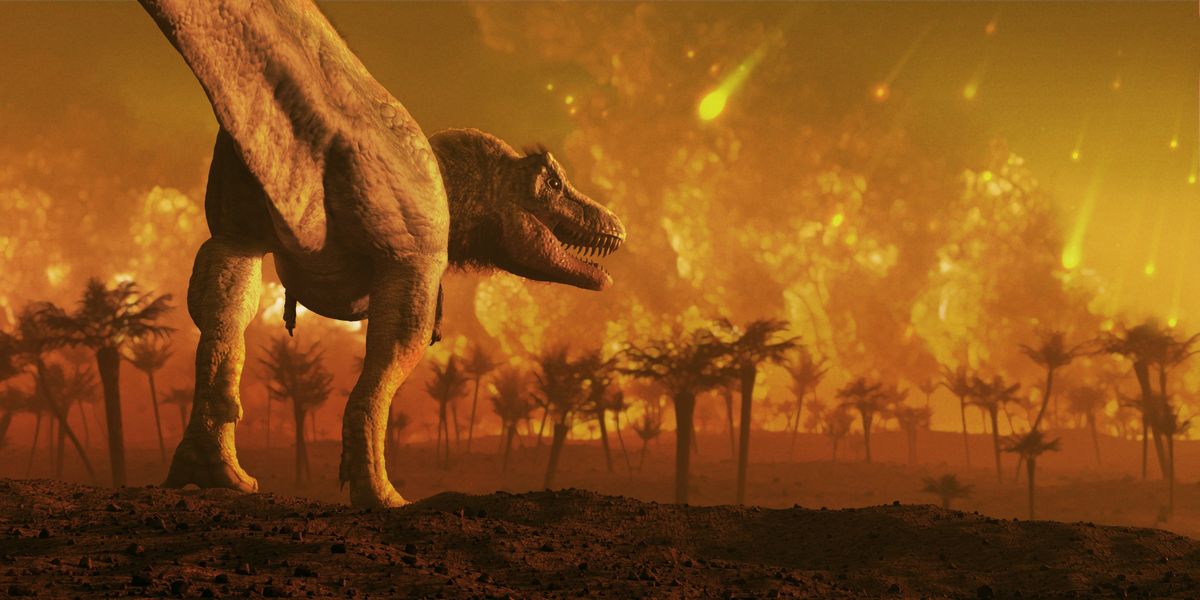
Instead, they were "charbroiled" in an "oven" left in the meteor's wake, the study says.
It has long been believed that dinosaurs were wiped out after an Everest-sized asteroid smashed into Earth at around 45,000mph, which is thought to have destroyed everything within a 900-mile radius.
However, a team of Purdue University planetary scientists believe a number of dinosaurs survived the initial impact, but were subsequently killed by a cloud of ejected dust.
This fine dust which blanketed the planet blocked heat from the impact escaping the atmosphere - meaning Earth cooked from the inside.
Atmospheric sciences expert Dr Alexandria Johnson said: “Anything that couldn’t shelter itself somehow - underground or underwater - would have got baked or fried.”
After smashing near the Yucatan Peninsula, the Chicxulub asteroid sent 240 cubic miles of material soaring into the atmosphere.
The material condensed into rock droplets, also known as spherules, which fell back towards Earth and heated up the planet even more.
Professor Brandon Johnson explained: "With the dust cloud trapping thermal radiation, it was like the surface and everything on it was being charbroiled - and that’s what killed the dinosaurs and all the other animals.
“It’s not the blast wave from the impact or the fireball - those don’t go very far.
"It’s the global ejection of this vapour plume material that makes this a global extinction event.
“Without the dust cloud, it would have been bad. It would have killed a lot of creatures, but it wouldn’t have been a planetary catastrophe.”
DINOSAURS - READ THE LATEST:
The asteroid is believed to have killed 75 per cent of all creatures on Earth - including the vast majority of dinosaur species.
Previously, researchers argued that the impact triggered natural disasters and plummeting temperatures due to the dust cloud blocking the Sun - but the fresh research suggests the demise of the dinosaurs came far quicker.
The heat trapped by the spherules left the dinosaurs to shoulder a dose of thermal radiation 17 times stronger than one which would be lethal to the human body.
The exceptionally high temperatures would have enough to set fire to grass and pine needles, sparking mass wildfires and turning the planet into a furnace.
Only creatures capable of burrowing or living in water could escape the blistering heat.
“The clouds would have blocked daylight so to any animal, like humans, that don’t see far into the infrared, the surface would have probably looked dark.”
The study was published in the Journal of Geophysical Research: Biogeosciences.