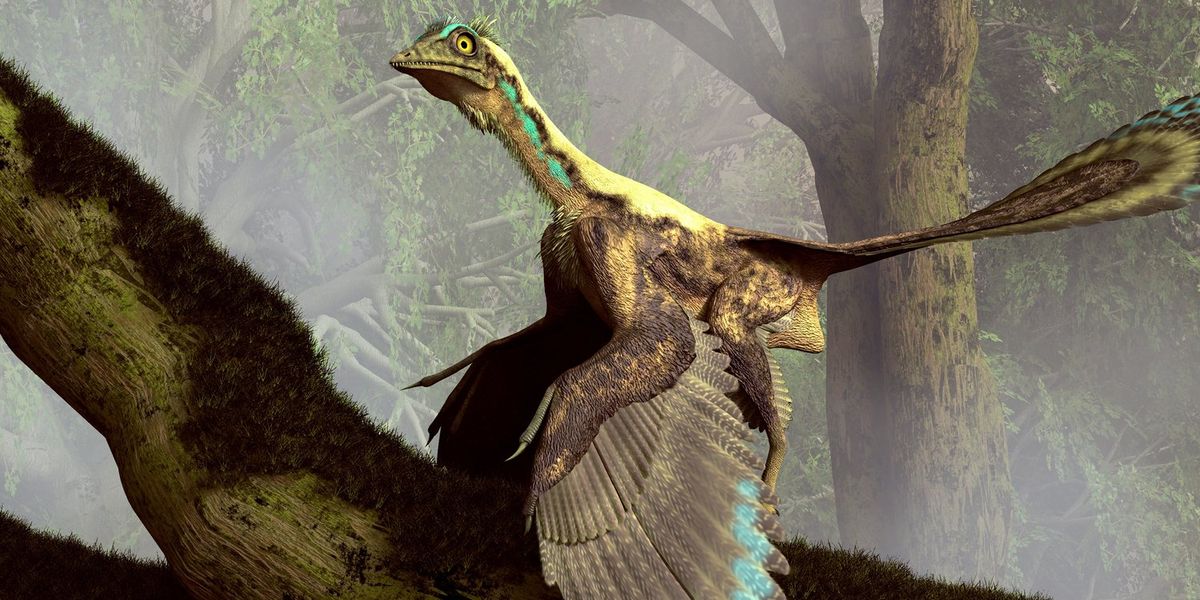
Roughly the size of a magpie or raven, the archaeopteryx was far from a refined flyer
Scientists at the University of Southampton have solved a long-standing puzzle about how the earliest birds managed to get airborne 150 million years ago, despite retaining numerous dinosaur-like traits.
Their research into the archaeopteryx reveals the creature relied on a series of hops to launch itself into the sky.
The team characterised the technique as "hop, hop and away."
The study, conducted in collaboration with the National Natural History Museum in Paris, sheds light on the crucial evolutionary shift from ground-dwelling dinosaurs to birds capable of powered flight, a question that has long baffled researchers.
Roughly the size of a magpie or raven, the archaeopteryx was far from a refined flyer.
Palaeobiologist Dr Neil Gostling described the species as "the first real bird".
He noted while it "was covered in feathers and possessed wings," it "also retained a number of distinctly dinosaur features, such as a long bony tail, claws on separate fingers, and teeth in a beakless jaw."
Crucially, the creature lacked a breastbone that could serve as an anchor point for strong chest muscles.
Its shoulder joints could not raise its wings above its back.
These missing anatomical features meant that the powerful, sweeping wing strokes needed to launch directly into the air from a standing start were simply beyond its capability.
Professor Markus Heller, a biomechanics expert at Southampton, explained the answer lay not in the wings but in the legs.
He said: "It turns out that is where take-off is won – the legs generate the force, and the wings take over afterwards."
The team studied the hip, knee and ankle movements of various modern birds, from gulls and finches to crows, to estimate the velocity the archaeopteryx would have required to become airborne.
Lead author Dr Erik Meilak said: "Our findings show that a mid-sized, 400g archaeopteryx could have achieved a sustainable flight speed of seven metres per second (16mph) with three bipedal leaps, or with two bipedal leaps with a downward flap between jumps."
He said: "Archaeopteryx would have either taken off with a leap, leap, leap and then lots of flapping, or a leap, a flap, another leap and more flapping."
Many contemporary species, including crows, magpies and seagulls, still employ multiple hops when taking off in relaxed circumstances.
They reserve the single-leap launch for moments of danger or stress.
The findings, published in the journal Developmental Biology, also carry broader evolutionary significance.
When an asteroid impact destroyed non-avian dinosaurs 66 million years ago, their avian relatives endured, owing to their smaller bodies, varied diets and, crucially, their capacity for flight.