


The Bank of England has kept interest rates unchanged at 3.75 per cent following its latest Monetary Policy Committee meeting.
Policymakers cited uncertainty over energy prices and inflation despite signs that domestic price pressures are easing.
Seven members voted to leave borrowing costs on hold at the June 17 meeting, while two members, Megan Greene and Huw Pill, preferred to raise Bank Rate by 0.25 percentage points to four per cent.
Consumer Price Index inflation (CPI) stood at 2.8 per cent in May, having remained unchanged from April after falling from 3.3 per cent in March.
Andrew Bailey, governor of the Bank of England, said: “We’ve held bank rate at 3.75 per cent today.
“Oil prices have fallen in recent days, and that’s encouraging. But they’re still higher than before the war.
“Whatever happens in the future, the higher energy prices of the past four months mean there’s already some inflationary pressure in the pipeline.
“The Bank’s job is to make sure that doesn’t turn into sustained inflation above our two per cent target.”
 Bank of England holds interest rates at 3.75 per cent | GETTY
Interest rates determine the cost of borrowing and the return on savings.
The Bank of England’s base rate is the benchmark it uses when lending to commercial banks and building societies.
Those institutions then use it to set the pricing of their own products, including mortgages and savings accounts.
Mortgage rates have risen in recent months, with the average two‑year fixed deal is now 5.59 per cent, compared with 4.83 per cent at the start of March, according to Moneyfacts.
Five‑year fixes have increased to 5.57 per cent, from 4.95 per cent over the same period.
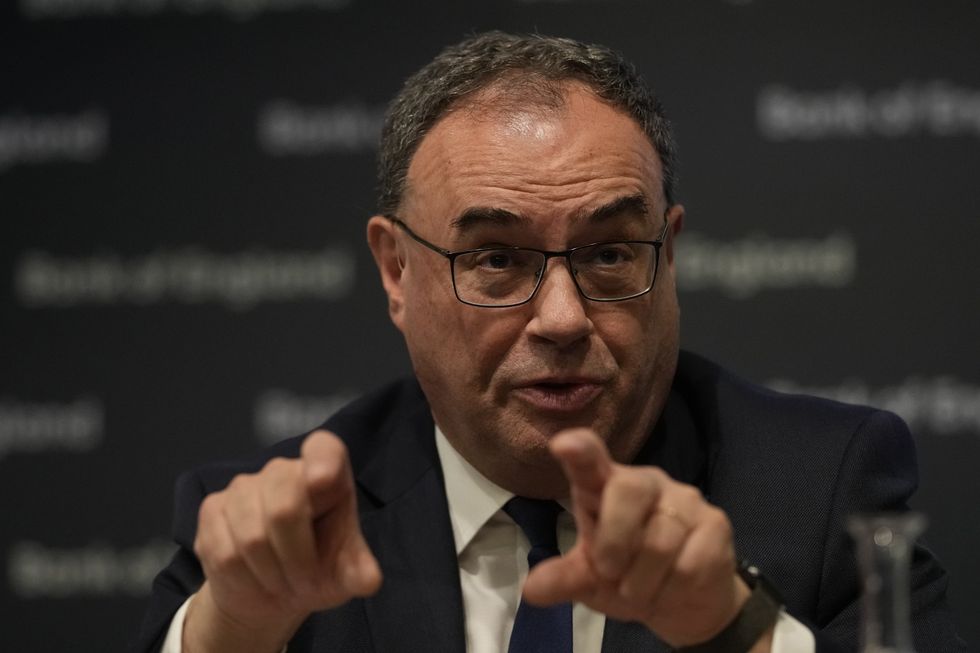
Andrew Bailey says the recent fall in oil prices is encouraging, but warned that the surge in energy costs during the US–Israel war with Iran means there is still “inflationary pressure in the pipeline”
|GETTY
The decision comes as policymakers continue to assess the implications of tensions in the Middle East and the impact of higher energy costs on households and businesses.
The Committee said it remained prepared to adjust monetary policy as necessary to return inflation sustainably to its two per cent target over the medium term.
Global energy prices have eased in recent days following announcements of a Middle East peace agreement, although they remain above levels seen before hostilities began.
LATEST DEVELOPMENTS
Brent crude prices fell to around $79 a barrel ahead of the June meeting, down from an average of approximately $100 since April.
UK wholesale gas prices also declined to around 100 pence per therm from 116 pence per therm.
However, these prices remain significantly higher than the $66 a barrel and 87 pence per therm recorded before the conflict escalated.
Commenting on the base rate hold, Kevin Brown, savings expert at financial mutual Scottish Friendly, says: “With tensions seemingly easing in the Middle East – and inflation remaining at 2.8 per cent for May – the backdrop to today’s Monetary Policy Committee meeting was not as fraught as may have been feared.

Market expectations suggest oil and gas prices are likely to continue moving lower over time
|GETTY
“Policymakers have now been handed evidence that inflation is not currently accelerating despite the Middle East energy shock.
"The picture is still far from rosy, but households can take some relief that the Bank of England has not piled a rate hike onto an already complicated picture.
“July’s higher energy bills have yet to feed through to households, while transport inflation has already jumped sharply on the back of fuel costs. Inflation therefore may yet climb before it falls."