Thank you for subscribing!
The figures come amid warnings that Britain’s jobs market is stuck in a 'low-hire, low-fire' cycle
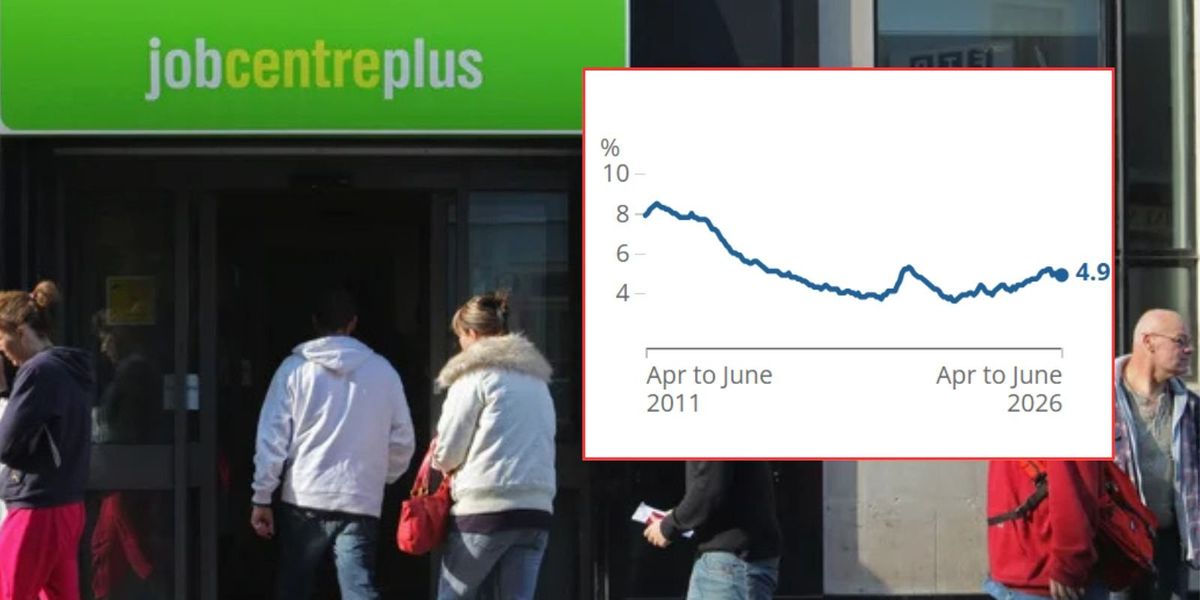
Britain's unemployment rate remained stuck at 4.9 per cent in the three months to June as businesses continued to hold back on hiring.
The figure was unchanged from the previous period and came in above some economists' expectations of 4.8 per cent, presenting an early challenge for Andy Burnham during his first month as Prime Minister.
Figures from the Office for National Statistics showed the number of payrolled employees fell by 13,000 between May and June and by 78,000 compared with a year earlier.
A provisional estimate for July pointed to a further decline, with 94,000 fewer employees on company payrolls than a year earlier.
Payroll employment also fell by 13,000 on the month to 30.3 million, although the ONS warned that the early figure could be revised.
The number of vacancies dropped to 707,000 in the three months to July, its lowest level since 2021, as firms remained reluctant to recruit amid uncertainty surrounding the Iran war and domestic politics.
Annual regular wage growth, excluding bonuses, edged up to 3.5 per cent in the three months to June. However, total pay growth including bonuses slowed to 4.1 per cent from the previous period.
Liz McKeown, ONS director of economic statistics, said the labour market was "little changed overall", although "some softening" remained evident.
She noted that employment, unemployment and inactivity rates had remained steady, while payroll employment fell slightly during the latest quarter.
Ms McKeown said vacancies were "broadly flat", but had slipped to their lowest level in more than five years. She attributed the decline mainly to smaller businesses, which cited labour and operating costs as reasons for “not hiring new staff or replacing leavers”.
She added that regular wage growth remained broadly stable, but private-sector pay growth continued to ease. Public-sector wage growth remained elevated because of the timing of the latest NHS pay awards.
Professor Joe Nellis, emeritus professor and head of economic research at MHA said the UK economy continued to "bump along without any momentum", with weak vacancies showing that the labour market was considerably less tight than a year ago.
He identified youth unemployment, which remains around 15 per cent, as a "defining issue" and warned that prolonged joblessness among 16 to 24-year-olds risked damaging their skills, future earnings and long-term participation in the workforce.
He urged the Government to encourage businesses to create jobs by improving hiring incentives and expanding apprenticeships and technical training.
Reducing youth unemployment should be a priority ahead of Andy Burnham’s first Budget as Prime Minister in October, he added.
Derrick Dunne, CEO of YOU Asset Management saidL "This morning’s ONS data shows that households are dealing with a stealth job market problem.
"While unemployment is stable at 4.9 per cent, the number of vacancies has fallen to its lowest level since November 2014 (excluding the pandemic).
"Employers are in retreat on hiring as the additional costs of employment – including national insurance and new workers’ rights – bite down hard.
"Although this may not necessarily be leading to joblessness, it will certainly not be helping the dynamism of the UK economy, as workers remain in jobs too long and others are unable to obtain pay rises through work moves."
Separate research from the Chartered Institute of Personnel and Development (CIPD) found that employer confidence in recruitment remained close to its weakest level outside the Covid-19 pandemic.
Its net employment balance, which measures employers' hiring intentions, remained at +9. The private-sector reading stayed at +11, matching its lowest level on record outside the pandemic.
Only 57 per cent of private-sector employers planned to recruit during the next three months, a joint post-pandemic low.
However, redundancies have not increased, leading the CIPD to describe the jobs market as a "low-hire, low-fire" environment.
The organisation also highlighted the difficulties facing younger workers, with around 735,000 people aged between 16 and 24 unemployed, equivalent to approximately 15.8 per cent.
It called on the Government to reduce the cost of employing staff and strengthen targeted support to help young people enter work.
Ministers have responded in part through a new TechFirst AI Apprenticeship Pathway, which launched this week in the north-west of England.
The pilot scheme offers up to 70 young people aged 16 to 21 three weeks of AI and workplace skills training, with apprenticeship opportunities at firms including JD Sports and Heinz available upon completion.
Digital, Culture, Media and Sport Secretary Lisa Nandy said: "We are tackling the youth unemployment crisis head on."