Culture Minister Olivia Grange says Jamaica will ask the King to refer three legal questions to the Privy Council
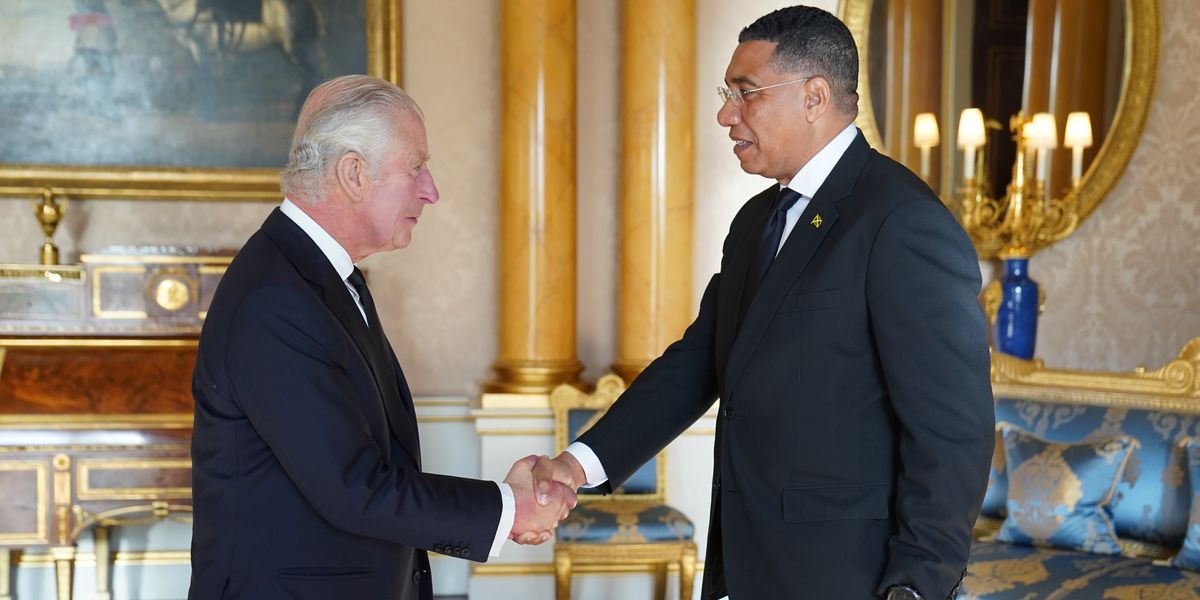
Jamaica has announced it will petition King Charles to refer a series of legal questions on slavery reparations to the Privy Council, marking the latest step in the Caribbean nation's long-running campaign for redress from Britain.
Culture Minister Olivia Grange confirmed the move at the annual Seville Emancipation Jubilee in St Ann, describing it as "the next step in the long journey for reparations."
The petition will ask the King, in his capacity as Jamaica's head of state, to refer three questions to the Privy Council: whether the forced transportation and enslavement of African people in Jamaica was lawful under the common law, whether it constituted crimes against humanity under international law, and whether Britain is under an obligation to provide a remedy to the Jamaican people.
Ms Grange indicated proceedings would begin within the coming weeks and said the initiative had the "full support" of the Caribbean Community (Caricom), stating: "Justice demands it."
The announcement came as Ghana's President John Dramani Mahama addressed a special sitting of Jamaica's Parliament on Tuesday, delivering a forceful call for reparatory justice during the final full day of a four-day state visit.
Mr Mahama told lawmakers that the transatlantic slave trade and the racialised chattel enslavement of Africans represented "the gravest crime committed to humanity," citing a recent United Nations resolution recognising the trafficking and enslavement of Africans as among the gravest crimes against humanity.
"History cannot be changed, but it can be acknowledged. And only by acknowledging it can we build a future that is founded on inspiration, justice and respect," he said.
The Ghanaian president argued that slavery's consequences had not ceased with abolition but continued to drive patterns of inequality worldwide.
He linked the pursuit of reparatory justice directly to accountability, the recognition of historical wrongs, and what he called "a collective determination to build a more just and equitable global order."
Mr Mahama also addressed the argument that African participation in the slave trade undermines demands for reparations, drawing a comparison with the Holocaust.
"Some of the most brutal prison guards were Jews. Some of those who went into the communities and showed where Jews were hiding and delivered them to the Nazis to be exterminated were Jews," he claimed. "But it doesn't mean the Holocaust didn't happen and that the Holocaust wasn't a crime against humanity."
While some Jewish prisoners were coerced by the Nazis into supervisory roles as prisoner functionaries, known as Kapos, historians note there were no official Jewish SS personnel or professional prison guards in the Nazi concentration camp system.
LATEST ROYAL DEVELOPMENTS
Mr Mahama argued the same principle applied to slavery, describing it as a highly organised system underpinned by legal frameworks, insurance arrangements, auctions and commercial networks.
The president also criticised how the history of slavery had been taught, recalling that his own schooling in Ghana lionised abolitionists as "knights in shiny armour" while giving insufficient attention to the suffering endured by millions of enslaved Africans.
Sir Hilary Beckles, vice-chancellor of the University of the West Indies and chairman of the Caricom Reparations Commission, said the Caribbean and Africa had forged a permanent alliance on the issue.
"Caricom and Africa will forever speak with one voice on reparations," he said.
According to supporters of the campaign, that cooperation has already produced diplomatic momentum, including backing from 123 countries for a UN General Assembly resolution recognising the trafficking and enslavement of Africans as among the gravest crimes against humanity.
According to the Brattle Report, prepared by economists at The Brattle Group for the University of the West Indies and the American Society of International Law, Britain's potential reparations liability has been estimated at approximately £18.6 trillion, based on calculations including lost liberty, lost earnings and intergenerational harm.
Despite this, the UK Government has repeatedly said it does not pay reparations for slavery.
GB News has contacted Buckingham Palace and the Foreign, Commonwealth & Development Office for comment.