Females and youngsters appear to be absent from some congregations, scientists have discovered
An archaeology breakthrough has revealed that ancient humans had a gender divide after million-year-old footprints were unearthed.
Footprints found near what is now Lake Turkana in Kenya have been dated to around 1.4 million years ago and have led scientists to make the startling discovery.
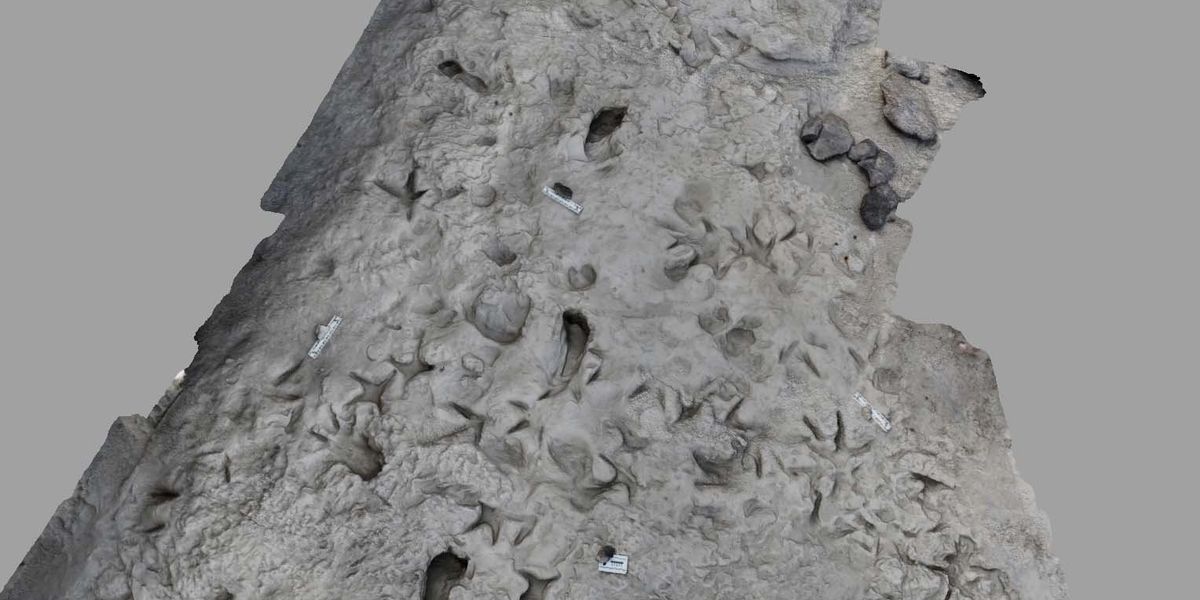
New research published in Proceedings of the National Academy of Sciences pinpointed the trackmakers as Paranthropus boisei — a stocky, heavy-jawed cousin of modern humans — and concludes that every individual in the party was male.
The complete absence of females and youngsters from the ancient group suggests that certain activities were undertaken exclusively by males, hinting at a degree of social organisation previously unrecognised in this species.
Scientists dated the trackway to approximately 1.43 million years ago using volcanic ash preserved in surrounding rock.
Perhaps the most unexpected finding concerns the physical stature of Paranthropus boisei.
Ahead of the discovery, the vast majority of known fossils from the species consisted of skulls featuring oversized jaws and teeth, leaving researchers with scant knowledge of the body below the neck.
Based on their robust bone structure, scientists had estimated males stood around 4ft 6in on average.
However, 2D and 3D analysis of the footprints, along with examination of foot shape and walking patterns, led to a "surprising" result.
"The sizes of the footprints indicate human-like body sizes up to 6ft tall and around 165lb," said Dr Kevin Hatala, an associate researcher at the Max Planck Institute for Evolutionary Anthropology in Leipzig.
The prints closely matched those left by Homo erectus, a neighbouring species long thought to be considerably larger than Paranthropus.
Dr Neil Roach, a Harvard University researcher and co-author of the study, said: "The fact that eight, adult male, P. boisei individuals seemingly travelled together as a group, without females or children, hints at a complex social structure in this species.
LATEST ARCHAEOLOGY BREAKTHROUGHS:
"They may have lived in large groups, where males competed for mates, but also tolerated each other at times for safety in a dangerous environment."
Among living ape species, males frequently build cooperative networks, collectively guarding territory, patrolling borders and hunting as a unit.
Dr Hatala said fossilised footprints represent the sole type of evidence capable of offering a direct glimpse into the social behaviour of species that no longer exist.
"This seems to indicate that this species lived in multi-male groups, with cooperation between adult males potentially being an important part of their social strategy," he said.
The trackway was originally found in 1978 by Dr Kay Behrensmeyer of the Smithsonian's National Museum of Natural History, but was deliberately buried in sand to safeguard it for later investigation before being recently re-examined.
"The special thing about footprints scientifically is that they preserve an instant in time," Dr Behrensmeyer said.
"They also allow people to relate to these fossils much more easily than an isolated piece of bone or jaw."
Altogether, the site yielded 21 hominin prints from eight individuals, alongside tracks from hippos, antelope and other creatures.
Hundreds of hominin footprints spanning more than 100,000 years have been uncovered across the East Turkana lakeside area in recent decades.