Scientists pored over the debris at the deadly blast site to uncover 30 mysterious particles
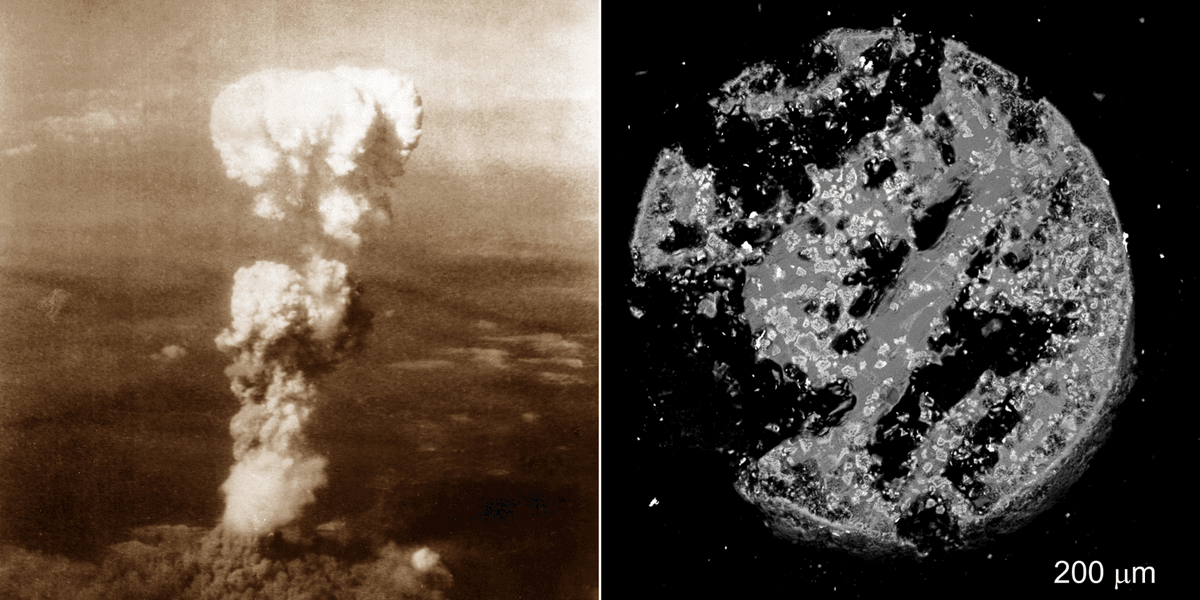
A strange new object, never seen before on Earth, has been discovered at the site of the Hiroshima atom bomb blast.
The previously-unknown metal was found at the place where the "Little Boy" bomb hit, killing more than 50,000 people.
Scientists analysed tiny grains within the debris, finding the alloy inside a glassy particle known as "hiroshimaite", recovered from beach sands in Hiroshima Bay.
The alloy contains iron, chromium, nickel, manganese, molybdenum, silicon and aluminium.
Some of the material resembles stainless steel, but its atoms arranged in a structure never before documented.
Researchers from the University of Florence believe the metal was vapourised by the fireball, then rapidly condensed, locking its atoms in an unnaturally occurring pattern.
The discovery, published in journal Science Advances, suggests that more novel post-nuclear materials could possibly be found.
Researchers analysed 34 tiny glassy particles collected from beaches in Hiroshima Bay.
These then used high-powered electron microscopes, conducted chemical analysis and single-crystal X-ray diffraction for any unusual material.
Thousands of known materials were compared to the alloy - confirming to the Florentine team they found something truly novel.
"We report the discovery of a previously unknown multicomponent alloy... recovered from beach sands of Hiroshima Bay, formed during the August 6, 1945 atomic airburst," researchers wrote.
"The alloy likely formed by condensation from a mixed metallic vapor followed by ultrafast quenching in the expanding fireball."
SCIENTIFIC DISCOVERIES - READ MORE:
The team, led by geologist Professor Luca Bindi, previously discovered a post-nuclear crystal which experts said should not be able to exist on our planet.
A gem, described as a "previously unknown calcium copper silicate type-I clathrate" was found at the site of the 1945 Trinity nuclear test in Alamagordo, New Mexico.
"Extreme, transient conditions produced by nuclear detonations can generate solid-state phases inaccessible to conventional synthesis," the researchers said.
Both findings show evidence that nuclear explosions can create new materials which would otherwise be impossible to create.
"This study demonstrates that anthropogenic (man-made) extreme conditions can lead to the formation of previously unknown materials," researchers said.
Prof Bindi has conducted extensive research into "quasicrystals" - finding the first naturally occurring example of one in 2009.
Crystals usually require stable conditions and lengthy periods to form neat, symmetrical patterns.
But quasicrystals lack translational symmetry and instead form in bizarre, unusual arrangements, appearing to be frozen in time after extreme conditions.