A New Jersey couple called the police and fire brigade for help - but neither turned up to help
A meteorite which smashed into a family home contains the ingredients to alien life, scientists have revealed.
The fireball was spotted hurtling across New York City in 2024.
At the time, Nasa said it was "incapable of surviving all the way to the ground".
But after it careered into a New Jersey family's home, researchers have been examining its contents.
They have discovered it contains amino acids, carbon compounds and other "prebiotic" molecules - the building blocks of life on our own planet.
A team of scientists, led by Peter Jenniksens, a meteor astronomer with affiliations at the Seti Institute and Nasa's Ames Research Center, praised the family for carefully preserved their fiery visitor.
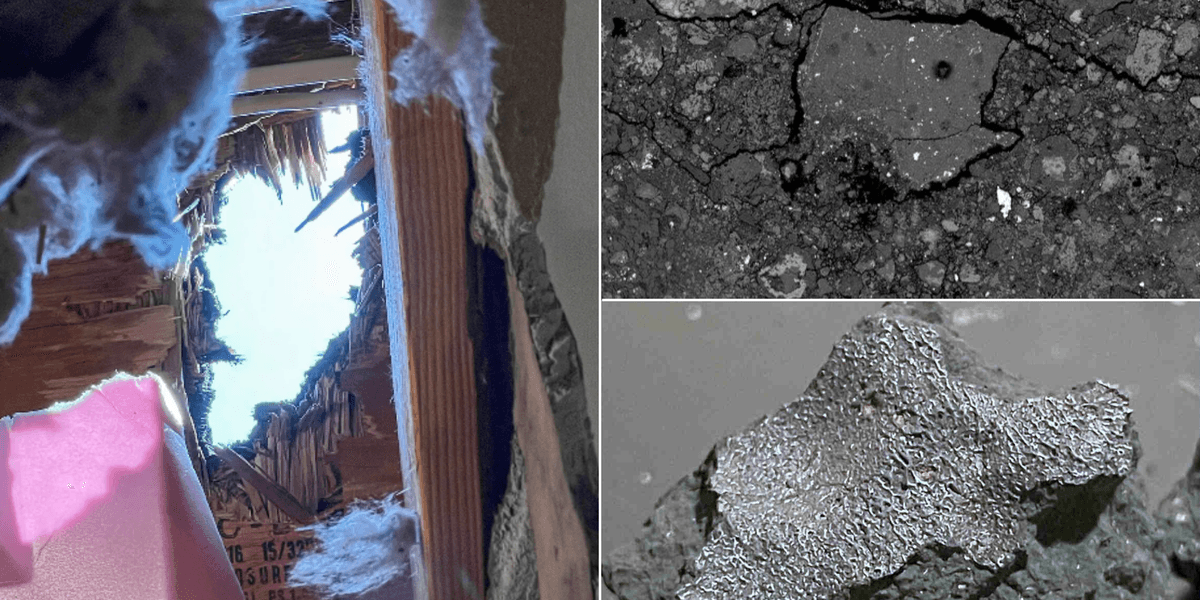
The homeowner heard an "immense crash" just three minutes later, he told The New York Times.
Describing the incident, he said in a statement from the Seti Institute: "I smelled a strong sulphur-like odor and saw many black fragments along with debris and black dust that covered my bed, carpet and surrounding areas."
The couple contacted the police and fire department to deal with the asteroid and damage to their home - but both declined to help.
They then came across Mike Hankey, an amateur astronomer at the American Meteor Society and co-author of the new study, after researching meteorite falls online.
Mr Hankey congratulated the couple, telling them at least $100,000 had just crashed through the roof.
"You've got to take good care of that. Every piece of dust you find is worth something," he recalled telling the couple.
The family then recovered every speck of meteor dust they could find, using tape to peel microscopic bits off the walls and purchasing a new vacuum cleaner just to suck up cosmic particles from the carpet.
One of the homeowners said: "We were extremely meticulous. The only thing we were missing were the hazmat suits."
LATEST SPACE NEWS:
Mr Jenniksens, leading the study, published in Science Advances, said the meteorite pieces likely came from an ancient solar system which had not yet been formed.
"A forensic study of the fragments revealed that they contained preserved bits from near the surface of a small primitive asteroid where it experienced concentrated salty fluids - a process not previously known from this type of protoplanet world," the lead astronomer said.
It makes it a specific kind of space rock known as a CM chondrite - hundreds have been recovered in the last century, but many were found long after they had reached the ground - making it only the second witnessed meteor fall of its kind.
The scientific community has said the meteorite is remarkable.
"It's what we always dream about," said Ashley King, a meteoriticist at the Natural History Museum, who was not involved in the study.
In addition to containing the prebiotic chemical compounds, the meteorite contained mineral alteration by salty water, which suggests it separated from a larger object with water flowing within it.
Analysis of the asteroid's flight path suggested pebble-sized pieces fell over a large area between Staten Island and Hillsborough - but none were found during several weeks of searching.