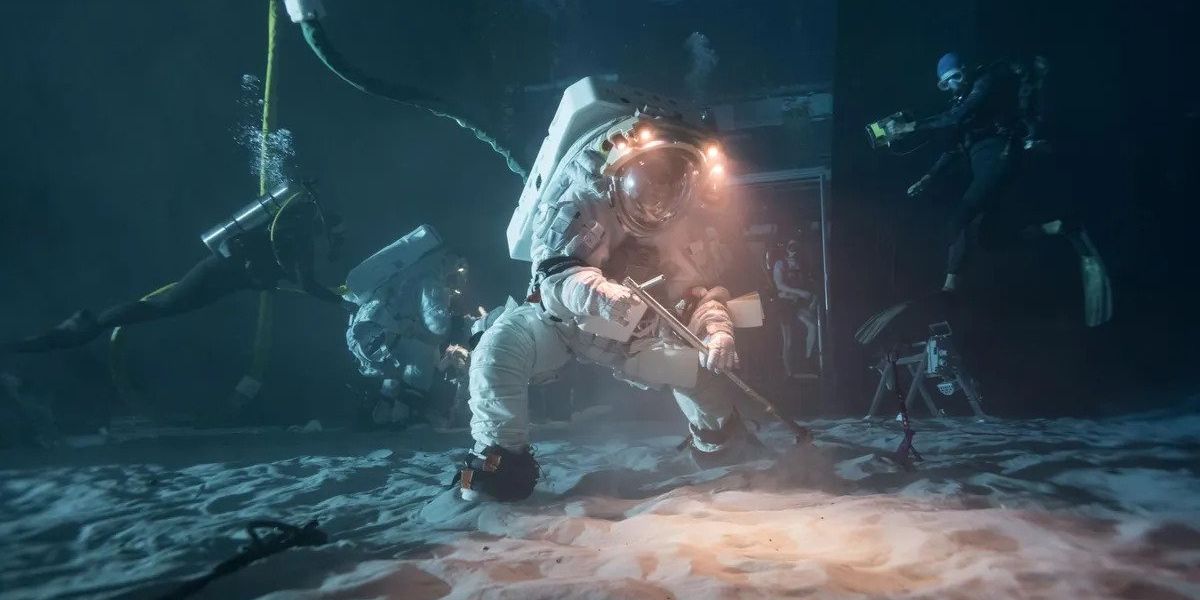
Officers wore prototype spacesuits whilst conducting geology exercises in the Neutral Buoyancy Laboratory
Two Nasa exploration geologists have completed a pioneering underwater training session at the space agency's facility in Houston, marking a significant milestone for the Artemis programme.
Trevor Graff and Angela Garcia, both serving as Artemis science officers, wore prototype spacesuits whilst conducting geology exercises in the Neutral Buoyancy Laboratory.
The session represented the first occasion a pair of geologists had simultaneously undertaken suited lunar geology training within the facility.
During the exercise, they practised operating geological instruments and positioning a simulated lunar payload, all whilst working in specially designed conditions.
The training forms part of preparations for the Artemis IV mission, which aims to return astronauts to the Moon's surface.
The underwater facility measures approximately 61.5 metres in length, 31.1 metres across and reaches a depth of 12.2 metres.
Nasa configured a section of this enormous indoor pool to replicate the lunar terrain, installing materials including rocks and soil that mirror conditions on the Moon's surface.
Engineers manipulated the water's buoyancy to recreate the reduced gravitational forces that astronauts will encounter during lunar exploration.
The scientists moved across the sandy, rocky floor whilst performing tasks such as kneeling and handling geological equipment.
Specially weighted spacesuits, combined with assistance from support divers, enabled the recreation of the low-gravity environment that characterises the Moon.
A critical element of the training involved replicating the lighting challenges that characterise the Moon's South Pole region, where Nasa intends to send future astronauts.
The scientists worked under deliberately dimmed, low-angle illumination designed to mirror the harsh visibility conditions they will face.
At the lunar South Pole, the Sun stays positioned near the horizon, generating extensive shadows that plunge numerous areas into perpetual darkness.
These permanently shadowed zones mean future explorers must be prepared to conduct scientific operations and navigate in extremely limited light.
The controlled lighting setup helps researchers comprehend how astronauts will function in this demanding environment.
Such conditions make navigation and scientific activities considerably more challenging than in well-lit areas.
Axiom Space, the company developing the next-generation lunar spacesuits, characterised the joint underwater session as an important milestone for forthcoming Moon missions.
The company stated the training would assist in refining the tools, procedures and scientific techniques that astronauts will ultimately employ on the lunar surface.
The Moon's South Pole serves as a prime destination because scientists believe that craters perpetually shrouded in darkness harbour water ice.
Studying these locations could unveil fresh insights into the Moon's history whilst potentially providing resources to sustain extended human presence.
Although the training did not involve the astronauts who will actually fly the mission, it fulfils a crucial function in their preparation.
By perfecting exploration techniques in a meticulously controlled setting that closely approximates lunar conditions, scientists aim to minimise mission hazards and enhance prospects for scientific achievement when humans once again walk on the Moon for the first time since 1972.