'It can help us understand some very basic laws of physics,' one expert said
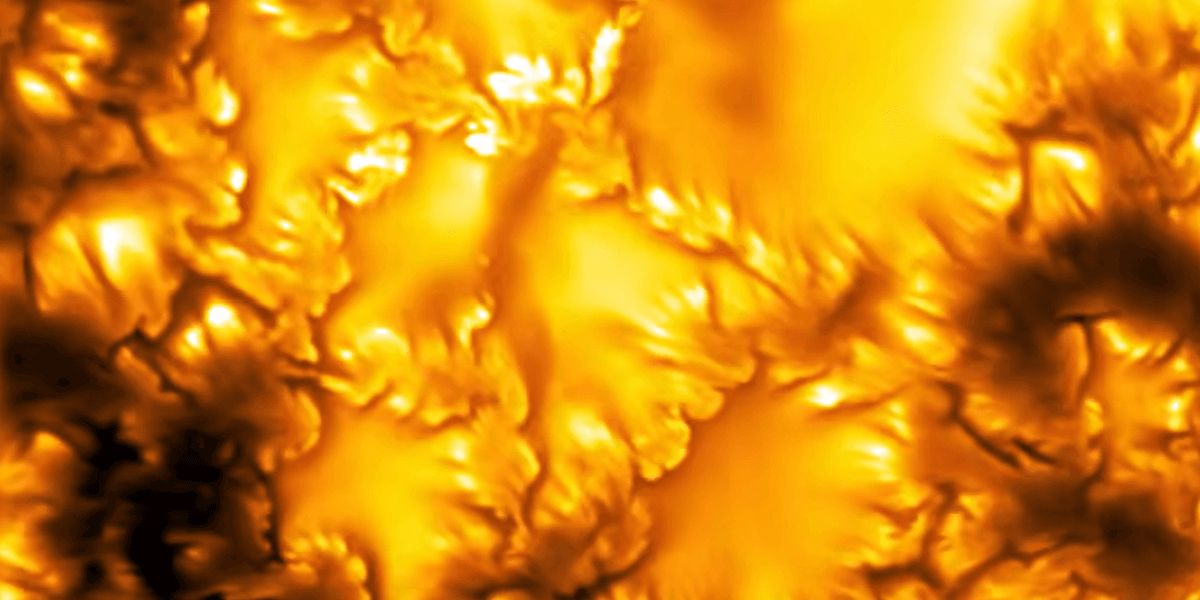
Astronomers have captured the sharpest-ever picture of the Sun in a "major step forward" to understanding our universe.
Scientists using the US National Science Foundation Daniel K. Inouye Solar Telescope - the world's most powerful - were able to detect detailed activity on the star.
Footage of the Sun demonstrate "whirlpools" of activity which have never been seen before, showing the magnetic field being twisted and moved.
The unusual movement is why the Sun can release short bursts of energy, dubbed "space weather", throwing Earth's satellites and power grids into disarray.
David Boboltz, from the US National Solar Observatory, external (NSO) said: "The Sun is the source of that energy and of all of that space weather.
"To figure out and eventually predict space weather, we want to understand the physics of the Sun, all the way down to the smallest scales."
NSO astronomer Dr David Kuridze explained that twisting motions create magnetic energy and can lead to large-scale explosions.
The explosive weather has been nicknamed as the "Kelvin-Helmholtz instability" within the science community.
"Kelvin-Helmholtz instability is likely a mechanism that contributes to the heating of the outer atmosphere and is part of the solution of the longstanding enigma of why stars have a million degrees Kelvin hot corona," Dr Thomas Rimmele, Chief Technologist at the National Solar Observatory, explained.
The remarkable marvel happens when fluids or hot gases pass by one another, creating minor disturbances which eventually becomes vortices.
The phenomenon is often compared to waves in an ocean gradually building momentum as small waves eventually become mammoth driving forces.
LATEST SCIENCE NEWS:
"Once there's enough energy wound up in the higher layers, it can then be released, as a flare or what's known as a coronal mass ejection," Dr Friedrich Woeger from the NSO told the BBC.
But Dr Boboltz explained the discovery will allow entrance into a "unique laboratory" to learn from the Sun.
"It's our closest star," he told the broadcaster. "And it can help us understand some very basic laws of physics.
"The first experimental proof of Einstein's general relativity came from solar eclipse observations.
"So simply for human knowledge, we need to have experiments like this."
The team is overjoyed with the discovery, with Dr Matthias Rempel, a senior scientist at the High Altitude Observatory, leading the way.
Be said: "It is very exciting to see that the highest-resolution observations of the solar photosphere revealed a new dynamical regime in the form of KH vortices at the edges of magnetic field concentrations.
"These observations also provide the highest resolution validation of solar magnetohydrodynamic simulations to date, and the agreement in physical details is impressive."