Nearly 75% of Britons fear more cyber attacks if digital IDs are introduced
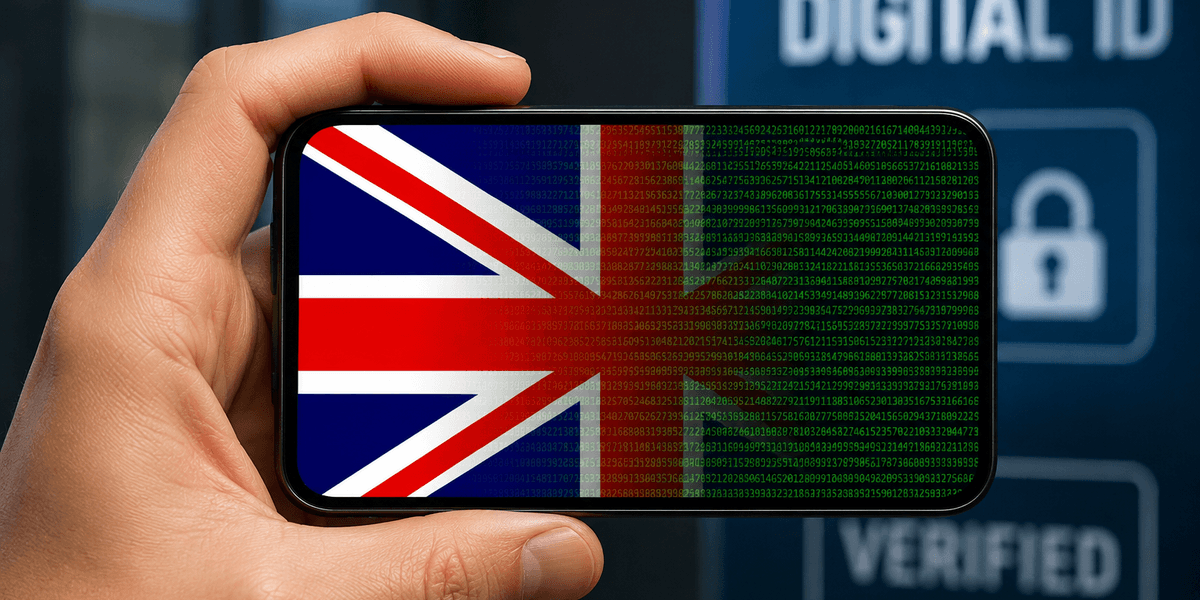
Over 60% of Britons have serious concerns about Government surveillance using digital identification systems, new polling data reveals. The survey, conducted by Deltapoll on behalf of civil liberties organisation Liberty, found that respondents worry their physical movements can be recorded whenever they use a digital ID.
The UK Government is developing a digital ID scheme primarily to reduce illegal employment, streamline access to public and private services, and crack down on identity fraud. This ID is meant to be a secure, verifiable, digital representation of your identity stored on your smartphone. It allows you to instantly prove who you are, your date of birth, and your right to work without needing to carry or photocopy physical documents, like a passport or utility bill.
It will build on the incoming digital driving licence, which will be included in the GOV.UK mobile app later this year.
Even more striking, nearly three-quarters of those polled — 74% — expressed anxiety about potential cyber attacks should the Government proceed with its digital ID rollout. And experts are saying that the concerns stemming from Britons are justified.
Evin McMullen, co-founder and CEO of Billions Network, told GB News: "These concerns aren't paranoid, they're driven by real things. Some proposed systems genuinely are centralised and do log usage. There's the association with social-credit-style databases.
"And there's a simple confusion between the ID, the device it lives on, and the system in which it is used: your handset and its apps already track you far more than a static file, like an identity credential, could. So the honest answer is that digital IDs can’t track you by themselves, but people are right to insist they be built and utilised in a way that doesn't. The architecture is the whole argument."
Liberty is now pressing Andy Burnham to scrap plans for expanding both digital ID and facial recognition technology should he assume the premiership, as widely anticipated.
The UK Government's digital ID scheme has endured a turbulent journey since Sir Keir Starmer unveiled it on the eve of last year's Labour Party conference.
Panayot Kalinov, Senior Software Developer at Casino Reviews, told GB News: "There is understandably a lot of fear about digital IDs because nearly everyone interacts with something daily that collects behavioural data. As such, many people assume that the way these new types of digital IDs work is similarly based on collecting data. Modern digital ID systems are largely based upon privacy-based design principles, specifically including minimising the amount of personal data disclosed and allowing for decentralised authentication."
When asked if Digital IDs can track your location, Ms McMullen said: "A digital ID has no GPS and doesn't inherently follow you around. Whether it can be used to track you comes down entirely to how it's built. A centralised design that 'phones home' to a server every time you use it leaves a trail the operator can see, where and when you proved who you were.
"A privacy-preserving design lets you prove the fact that's needed, that you're over 18, a resident, a licence-holder, without the issuer ever learning where or when you used it. Same goal, opposite privacy outcome. The technology to do it the private way already exists."
Rebecca Moody, Head of Data Research at Comparitech, also sheds light on the data required to create a Digital ID, telling GB News: "This depends on the country in which the digital ID is issued and for what purpose. In some cases, digital IDs can be linked to Government databases, tying in financial data, health information, employment, and more.
"Often, digital IDs are linked to national ID cards, and some require facial recognition/biometrics. When these are connected to a centralised database, this creates huge privacy concerns for several reasons.
"For example, it creates a single point of failure (if the database goes down, citizens can be locked out of key services), it leaves the database (and citizens' data) vulnerable to external attacks and breaches, and it can be used for mass surveillance."
Digital identity systems are widely used across the world, although the way they operate varies from country to country. Commonly, they allow people to confirm their identity online when using services such as UK Government websites, banks and healthcare providers.
Estonia has been a pioneer in digital identity, introducing a compulsory national system in 2002. It is used for a wide range of everyday activities, including accessing health records, voting online, managing banking services and signing official documents electronically. Many Estonians now carry a digital version of their ID card on their smartphones.
On the other hand, Australia and Denmark have adopted voluntary digital identity schemes. People who choose to use them can download official apps to securely access Government services and, in some cases, private-sector platforms, but there is no requirement for citizens to sign up.
India's Aadhaar programme provides residents with a unique 12-digit identification number that can be used to verify both identity and place of residence when accessing a variety of public and private services.
Digital identity programmes have also been introduced in many other countries, including Singapore, Greece, France, Bosnia and Herzegovina, the United Arab Emirates, China, Costa Rica, South Korea and Afghanistan.