Thank you for subscribing!
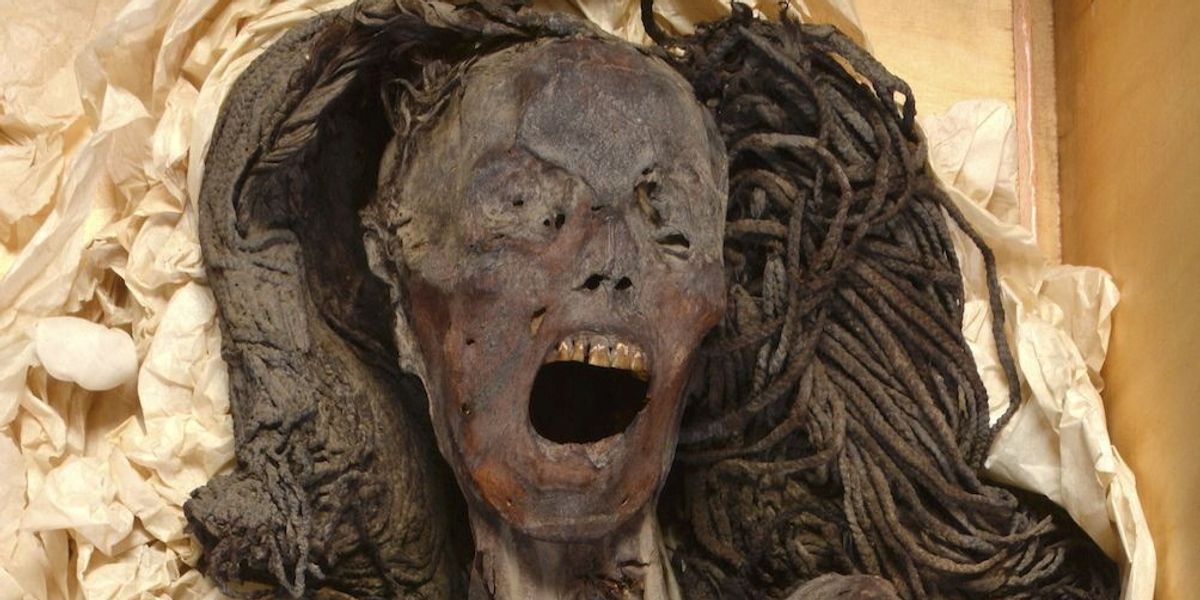
The 'screaming woman' was first unearthed by archaeologists in 1935 and has baffled experts ever since
A team of researchers at Cairo University may have cracked a 3,000-year-old mystery surrounding an Egyptian mummy whose face appears frozen in a horrifying scream.
The unidentified female corpse, dubbed the "screaming woman," was first unearthed by archaeologists in 1935 and has baffled experts ever since.
Her contorted, tilted face - shaped unmistakably into what resembles a scream - was long attributed to a botched embalming process.
Now, after subjecting the mummy to X-rays and CT scans, scientists believe her expression may instead reflect genuine suffering at the moment of death, a phenomenon known as cadaveric spasm.
The mummy was placed in luxurious fashion, laid to rest alongside royal architects and other figures connected to the pharaoh Hatsheput.
Far from the botched burial one might expect if her embalming had simply been mishandled, she was surrounded by costly imported frankincense and juniper resin.
She also wore an elaborate wig crafted from date-palm fibres, coloured with expensive reddish henna and dusted with crystallite powder.
Adding to the puzzle, her internal organs had never been removed - a departure from standard mummification practice - and her abdomen bore no incision marks whatsoever.
The research team, which included a mummy radiologist from Cairo University, carried out their analysis to determine what might explain the woman's anguished expression.
Their findings, published in the journal Frontiers in Medicine, pointed towards cadaveric spasm as the most likely explanation.
The study stated: "The mummy's screaming facial expression in this study could be read as a cadaveric spasm, implying that the woman died screaming from agony or pain."
It added: "Embalmers likely mummified the contracted body of the woman before it decomposed or relaxed, thus preserving her opened mouth position at death."
The researchers also noted that the seized muscles may have physically prevented the embalmers from shutting her mouth.
Should this interpretation prove correct, it would mean that ancient Egyptian embalmers acted with sufficient speed to preserve the woman's body before her muscles had a chance to relax, effectively capturing her final moments of agony.
Whatever caused this woman's death, her suffering was so intense that it left a permanent physical imprint, one that has endured for three millennia.
If the cadaveric spasm theory holds, the embalmers inadvertently froze not merely a body, but the very last, agonising seconds of a life lived more than 3,000 years ago.